What is me and not me: Pilocybin and the Metal Phase
People often describe psilocybin experiences in terms of expanded awareness, softened identity, or a temporary shift in how they experience themselves in relation to the world. The sense that a person is not actually an individual but is part of a massive, univeral whole is so pervasive in descriptions of mushroom journeys, even among people who have very little else in common, that it seems like the mushrooms are exposing some larger truth. And whenever we start talking about the wider order of things in the universe, my philosophy nerd-self is immediately invigorated and I reach for the philosophical system I know best - Daoist and Confucian thought.
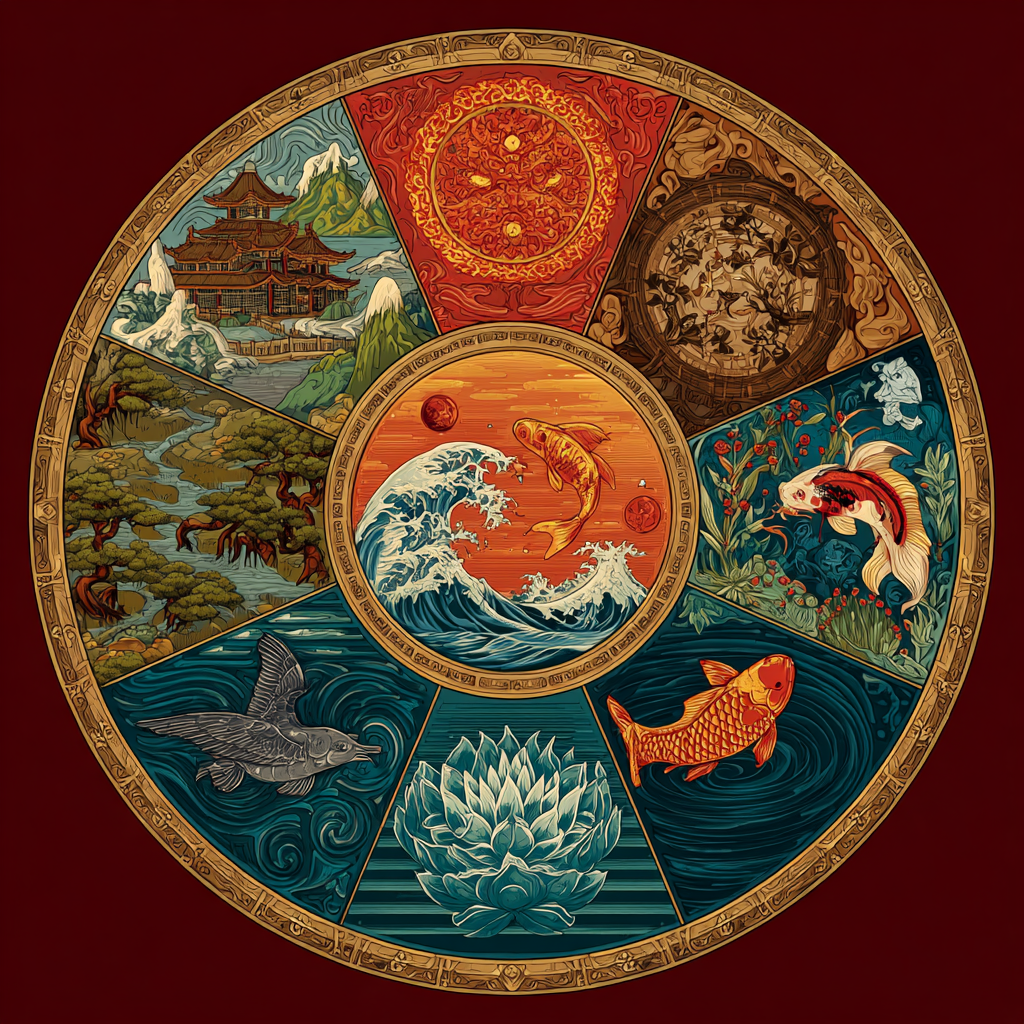
In my day job as a Chinese medicine clinician, I’ve been wondering a lot about how Psilocybin fits into our Chinese cosomological world view. From our perspective, these common descriptions of the journey space point toward a specific functional system in our medicine rather than a vague or generalized symbolic idea. That system is what we call the Metal phase.
Chinese medicine uses the framework of Five Phases to describe patterns of function and change within the body. The term “phase” is important here. These are not static elements or personality types. They are ways of describing how the body organizes movement, perception, emotion, and physiology over time. Each phase represents a particular mode of relationship between the individual and their environment.
Metal is the phase concerned with boundary and discernment. It governs how the body defines what belongs inside and what remains outside, what is taken in and what is released. The organs associated with Metal are the Lungs and the Large Intestine. Together, they manage exchange. The Lungs oversee respiration, skin, and the surface of the body, regulating contact with the external world through breath and sensation. The Large Intestine completes the digestive process by separating what is useful from what is waste and facilitating its release.
At a physical level, the Metal phase shows up in breathing capacity, sinus clarity, immune resilience, and the health of the skin and mucous membranes. At a psychological level, it relates to our capacity for discernment, grief, completion, and letting go. It is the phase that allows a person to experience themselves as a coherent individual while remaining in relationship with the much larger world around them.
Psilocybin appears to interact strongly with this domain of function. One of the most consistent features of psilocybin experiences is a softening of the sense of separation between self and environment. People often report that the usual boundary defining “me” feels more permeable. Thoughts, emotions, and sensory input are experienced with less filtering, and the sense of being a discrete observer can give way to a more relational experience of awareness.
From a Chinese medicine standpoint, this can be understood as a temporary loosening of Metal’s organizing role. The functional boundaries that define being a human being relax or dissolve and t becomes more flexible for a period of time. This shift can be observed physically as well as psychologically. Many people notice changes in breathing during psilocybin sessions, including deeper inhalations, spontaneous sighing, or a sense of openness through the chest and sinuses. These changes align closely with the Lung’s role in governing breath and surface exchange.
The Large Intestine’s function of release also has a clear parallel here. Psilocybin experiences frequently involve the letting go of entrenched narratives, fixed self-concepts, or long-held emotional material. This process is often described as relieving or clarifying rather than chaotic. In Chinese medicine, the physiological and symbolic dimensions of release are understood as expressions of the same underlying movement. The body does not separate metaphor from mechanism in the way modern language often does.
What matters clinically and educationally is that this Metal softening is transient. The goal is not a permanent loss of boundary, but a temporary shift that allows new information and perspective to emerge. When the experience is well supported and integrated, people often return with a more functional relationship to boundary rather than a weakened one. They may find it easier to release outdated patterns, to tolerate grief or transition, and to reestablish a sense of self that feels more responsive and less defended.
Viewed through the lens of Chinese medicine, psilocybin does not impose an external state onto the system. It appears to modulate an existing phase of function, offering a brief reorganization of how boundary, breath, and release are experienced. This perspective emphasizes process rather than pathology and helps situate psilocybin experiences within a broader framework of physiological and psychological regulation.
Chinese medicine has long held that health depends on flexibility within structure. The Metal phase reflects this principle clearly. Boundaries must exist, but they must also be able to soften and reform. Psilocybin may offer a temporary opportunity for that softening, allowing the system to recalibrate how it distinguishes, relates, and lets go.